



Need Flatbed Transporter Lifting for Faster, Safer Moves?
Underground moves made simple: why mines are switching to lifting flatbeds
Every few years a quietly practical idea changes how work gets done underground. The new Flatbed Transporter Lifting is one of those. Built in the Shijiazhuang High-tech Industrial Development Zone, Hebei Province, it combines a low-slung carrier with a stabilized lifting deck that can go up to about 4 metres and, crucially, can lift while parked on a 16° slope thanks to deployable support legs. On paper it sounds simple. In the gallery—actually in the drifts—it’s a time-saver.
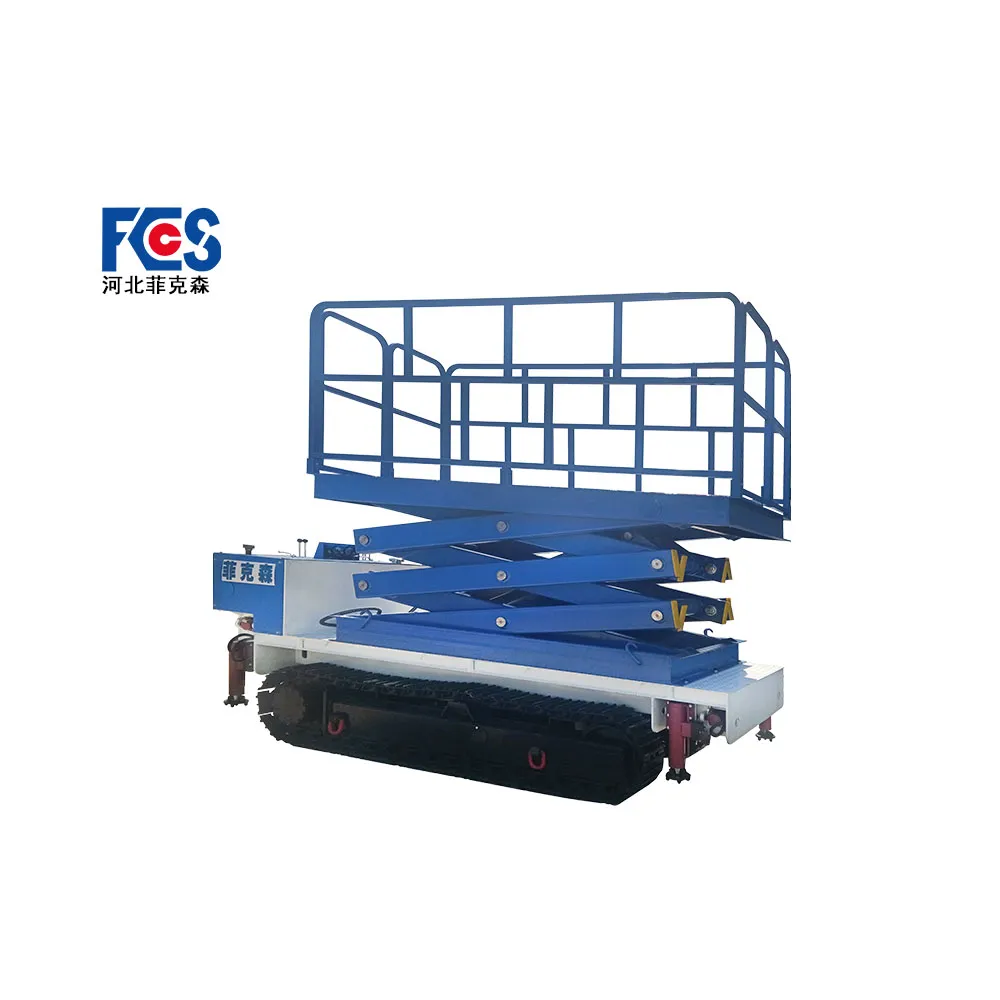
Industry trend check
Across coal and hard-rock operations, maintenance teams are trimming non-productive tramming and crane calls. Multi-purpose carriers with safe lifting capability are replacing ad-hoc rigs. The push is driven by three things: tighter safety regimes (ISO 12100 style risk reduction), electrification interest underground, and sheer schedule pressure. To be honest, the most surprising bit is how fast crews adopt them—many customers say the “lift where you stop” model won back hours per shift.
Typical specifications (real-world use may vary)
| Payload capacity | ≈ 8–15 t (configurable) |
| Platform lift height | Up to ≈ 4 m |
| Gradeability / lifting on slope | Tram ≥ 16°; stabilized lifting on 16° with support legs |
| Deck size | ≈ 3.5 m × 2.2 m (options available) |
| Hydraulic system | High-pressure, load-holding valves; emergency lowering |
| Power | Diesel or battery-electric options, flameproof kits available |
How it’s built (materials, methods, testing)
Materials: high-strength structural steel (e.g., Q345-class) chassis, abrasion-resistant deck, sealed pins and bushings. Methods: robotic and manual welding with WPS/PQR, stress-relief where required, precision machining on stabilizer legs, IP-rated harnessing. Testing: static proof load at ≈125% of rated; dynamic at ≈110%; brake-hold on 16°; cylinder drift ≤ 5 mm/10 min; platform deflection target ≈ L/300. Certifications typically offered: ISO 9001 for QMS, MA mark for coal-mine safety in China, optional IECEx/ATEX flameproof electrics. Service life: around 8–12 years with planned mid-life overhaul—obviously duty cycles vary.
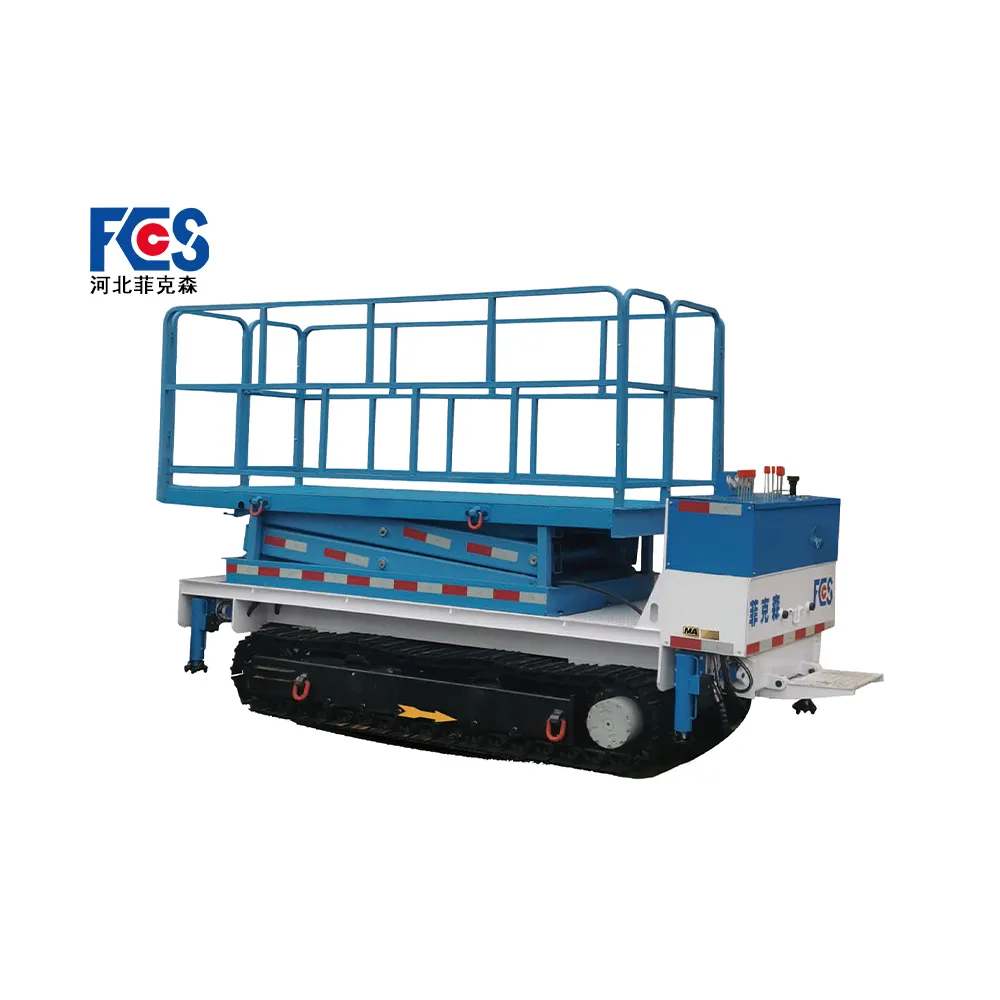
Application scenarios
- Coal mine material runs: roof bolter parts, shields, pump skids to longwall faces.
- Station works: shaft stations, crosscuts—lifting pipes, cable reels, ventilation tubing.
- Safety installations: rib/roof protection panels where a man-basket can be mounted on the deck.
Advantages we keep hearing about
- Set up on a 16° incline—support legs steady the lift without calling a separate crane.
- Tighter scheduling: one unit transports and lifts; fewer handoffs.
- Safety: fail-safe SAHR braking, stabilizer interlocks, overload protection, emergency lowering.
- Customization: deck fixtures, flameproof packs, battery-electric variants for low-vent areas.
Vendor comparison (quick view)
| Vendor | Slope-lift capability | Lift height | Certifications | Lead time | Customization |
|---|---|---|---|---|---|
| FCCS (Hebei) | Yes, ≈16° with legs | ≈4 m | ISO 9001, MA; optional IECEx/ATEX | ≈ 8–12 weeks | High (deck, power, controls) |
| Vendor A | Partial (≤10°) | ≈3 m | ISO 9001 | ≈ 10–16 weeks | Medium |
| Vendor B | No (flat only) | ≈2.5 m | CE | ≈ 6–10 weeks | Low |
Real-world notes and test data
A Shanxi maintenance lead told me—half laughing—that the first week with the Flatbed Transporter Lifting shaved “two crane calls a shift.” Factory tests logged 125% static load with ≤ 3 mm deck set, and a 16° slope brake-hold at 120% payload. Not every pit will match that, of course, but the pattern is solid.
Customization roadmap
- Deck options: rails, pipe cradles, man-basket (where permitted by regulation).
- Powertrain: diesel with DPF, or battery-electric with fast-charge—both with flameproof packages where required.
- Controls: radio remote, proximity beacons, data logging for maintenance.
If you’re mapping out upgrades, the Flatbed Transporter Lifting makes the most sense where gradients are part of daily life and schedule friction is the enemy. That’s most mines I visit, honestly.
Authoritative references
- ISO 12100:2010, Safety of machinery — General principles for design — Risk assessment and risk reduction.
- IEC 60079-0/1: Explosive atmospheres — Equipment general requirements and flameproof enclosures.
- China National Mining Products Safety Mark (MA) — Catalogue and Rules, National Center for Safety Mark of Mining Products.
- MSHA 30 CFR Part 75 — Mandatory Safety Standards, Underground Coal Mines.